

Ground Vibrations Reduced by a Factor of 1,000
Binnig and Rohrer Nanotechnology Center at IBM Research Laboratories: Combined Sound and Vibration Isolation for Noise-Free Laboratories
Project Overview
Customer
Binnig and Rohrer Nanotechnology Center at IBM Research Laboratories
Industry
Metrology & Precision Equipment, Research Labs
Application
Products Used
Key Facts
Ground Vibrations Below 10 Hz
- Target value: less than 1 μm/s
- Measured result: less than 0.3 μm/s
Ground Vibrations Above 10 Hz
- Target value: less than 0.5 μm/s
- Measured result: less than 0.1 μm/s
Sound Pressure
- Target value: less than 55 dBC
- Measured result: less than 22 dBC
Background
The Binnig and Rohrer Nanotechnology Center at IBM in Zurich focuses on advanced research in nanoscience.
Researchers at the centre study extremely small structures in the nanometre range to develop new materials and technologies for applications such as information technology and semiconductor manufacturing.
Because research is carried out at such a small scale, the laboratories require exceptionally stable environmental conditions.
Even very small disturbances caused by vibration, sound, temperature changes, humidity or electromagnetic fields can influence sensitive measurements and experimental results.
A New Laboratory Concept for Nanotechnology
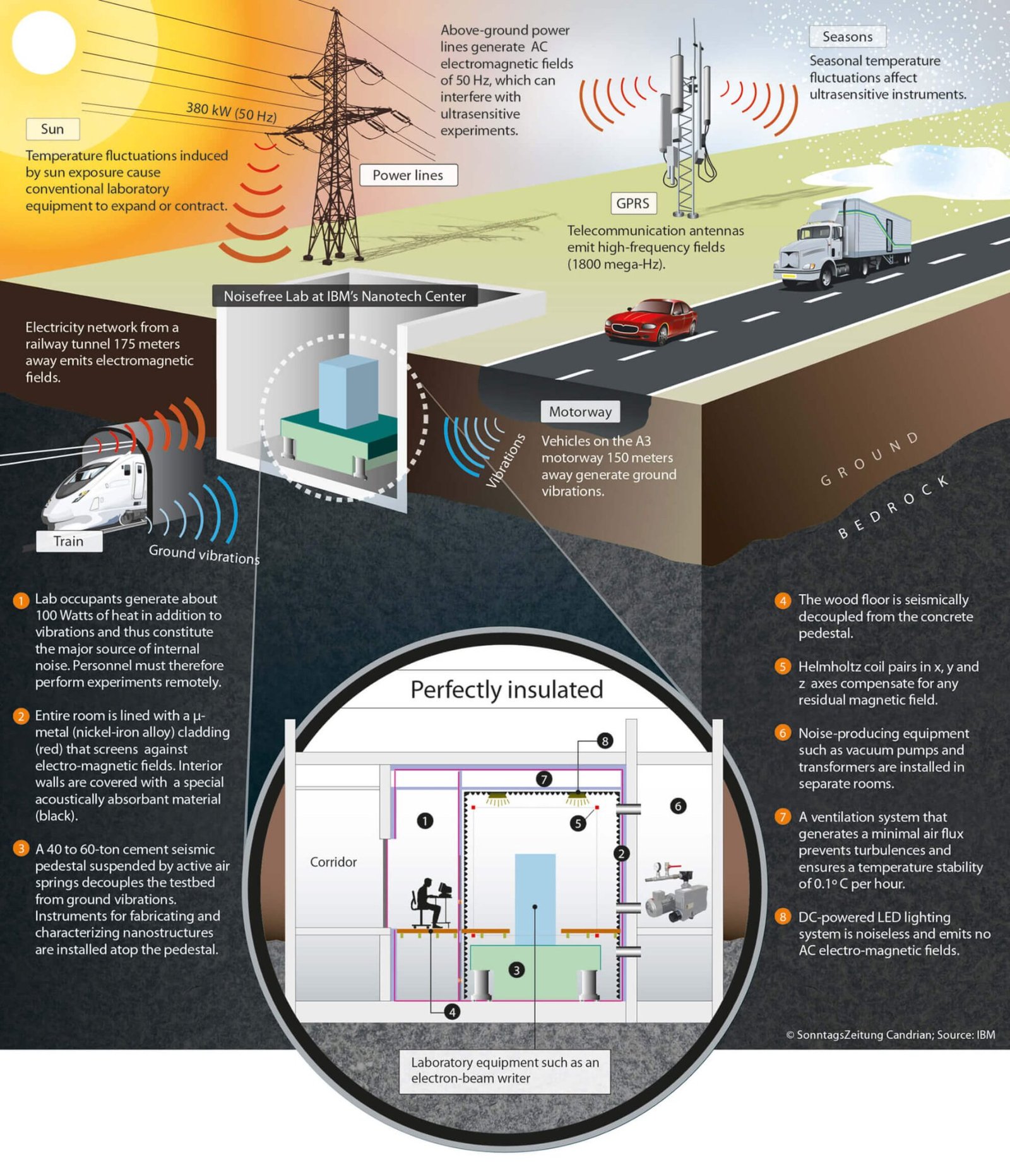
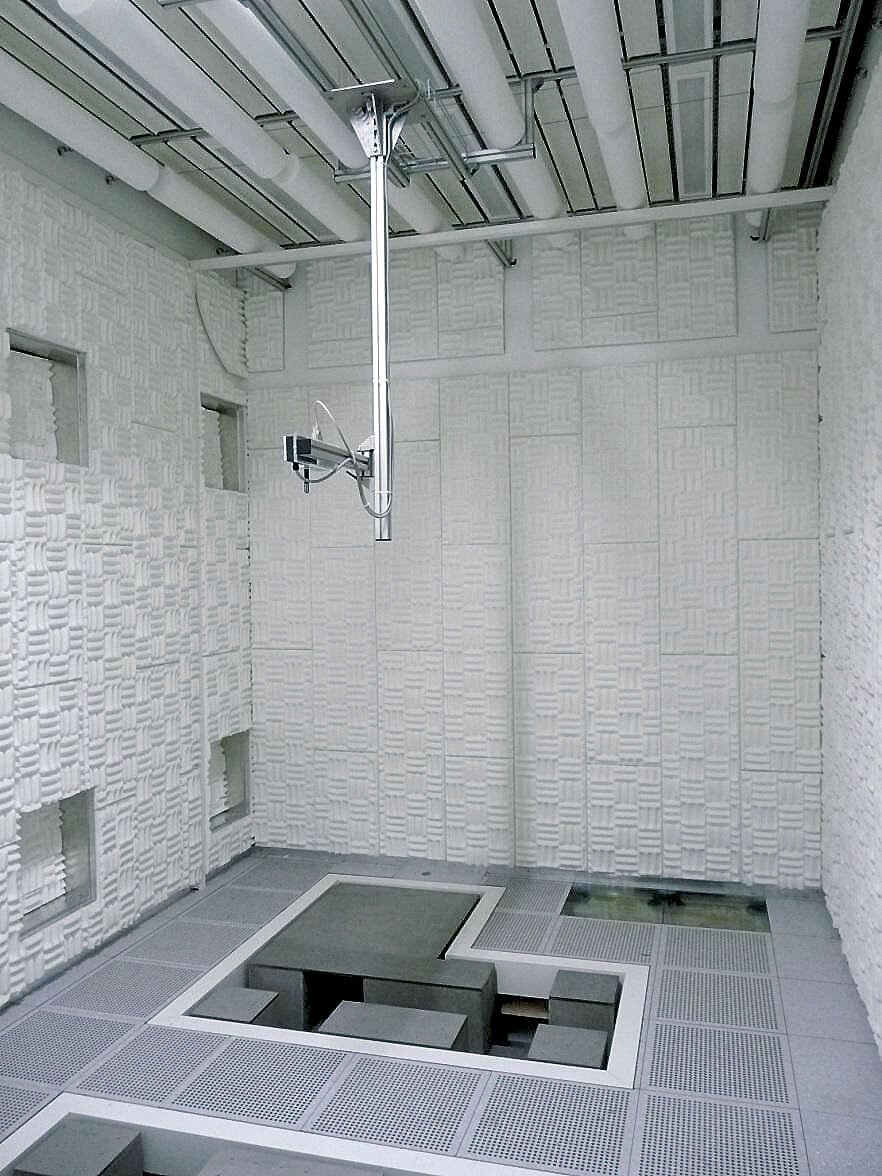
The nanotechnology centre includes six specially designed noise-free laboratories located approximately eight metres underground.
These laboratories are used for some of the most sensitive and technically demanding experiments in nanoscale research.
To create suitable conditions for this work, all major environmental disturbance factors had to be considered and reduced as much as possible.
These included:
- Ground vibrations
- Airborne sound
- Electromagnetic fields
- Temperature variations
- Humidity changes
Meeting these requirements demanded a completely new laboratory concept.
Bilz was involved in the planning of the IBM Research noise-free laboratories from an early stage.
Following detailed technical consultation, testing and evaluation, Bilz developed a combined solution for:
- Isolation from ground vibrations
- Airborne sound insulation
- Optimisation of room acoustics
The Challenge
The main objective for the six noise-free laboratories was to ensure that environmental conditions inside the laboratory would deteriorate as little as possible during experiments.
One of the major challenges was that the technical equipment required for experiments can itself generate disturbances.
Examples include:
- Mechanical vacuum pumps
- Heat generated by equipment
- Electrical power systems
- Control equipment
- Electromagnetic radiation
In conventional laboratory experiments, it may be sufficient to control only one parameter, such as temperature.
However, highly sensitive nanotechnology measurements can be affected by several disturbance factors simultaneously.
Therefore, the laboratory design had to minimise:
- Temperature fluctuations
- Humidity variations
- Mechanical vibrations
- Airborne sound
- Electromagnetic fields
These challenges could only be addressed by considering the laboratory as one complete technical system.
Task 1: Ground Vibrations
During the initial project phase, several highly sensitive experiments and research instruments were evaluated.
Equipment included:
- Electron beam recorders
- Transmission electron microscopes
- Spin-polarised scanning tunnelling microscopes
- Other highly sensitive measuring and fabrication equipment
These instruments had to be installed in an environment with extremely low vibration levels.
Solution 1: Air-Cushioned Foundation Blocks
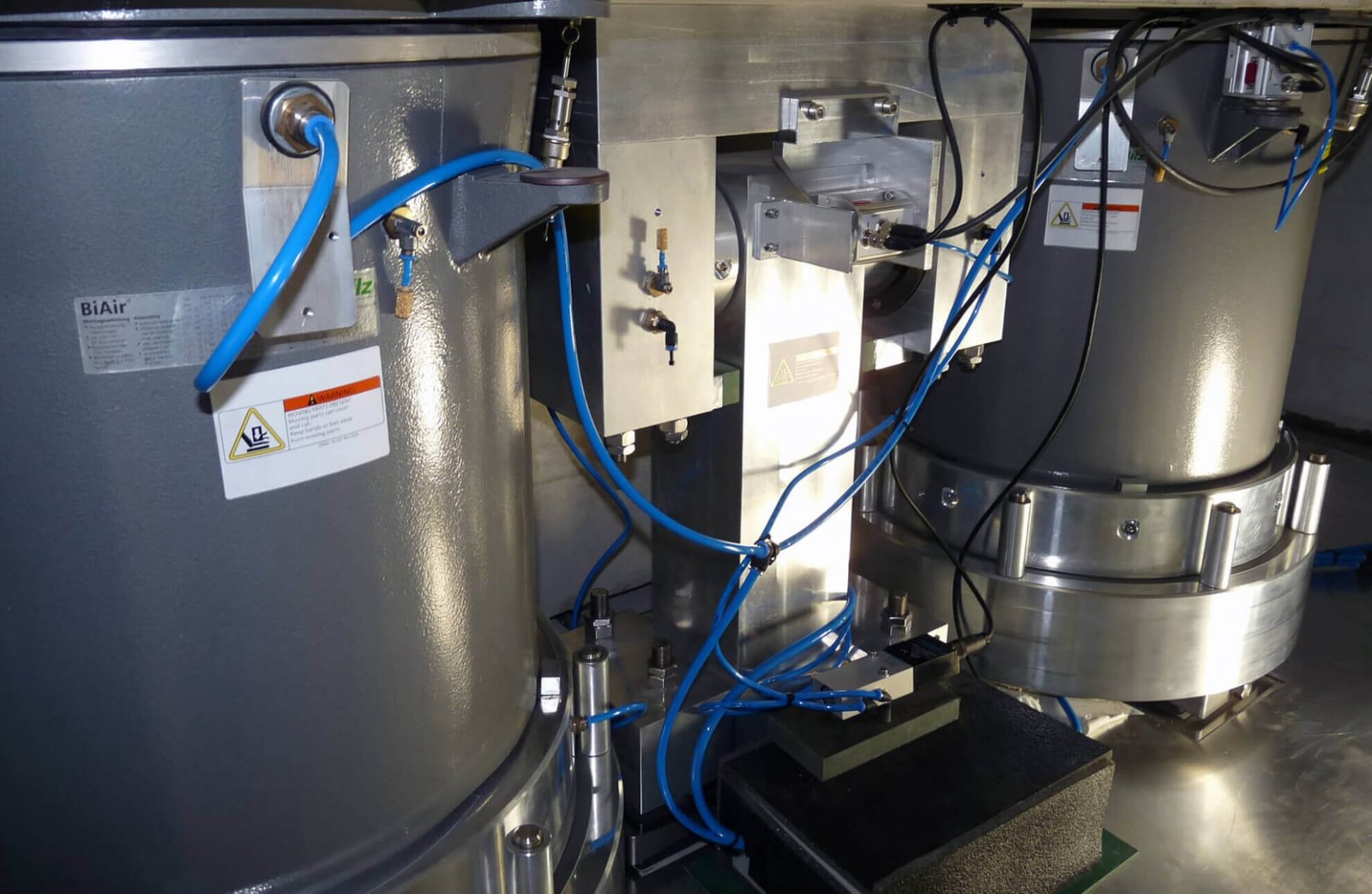
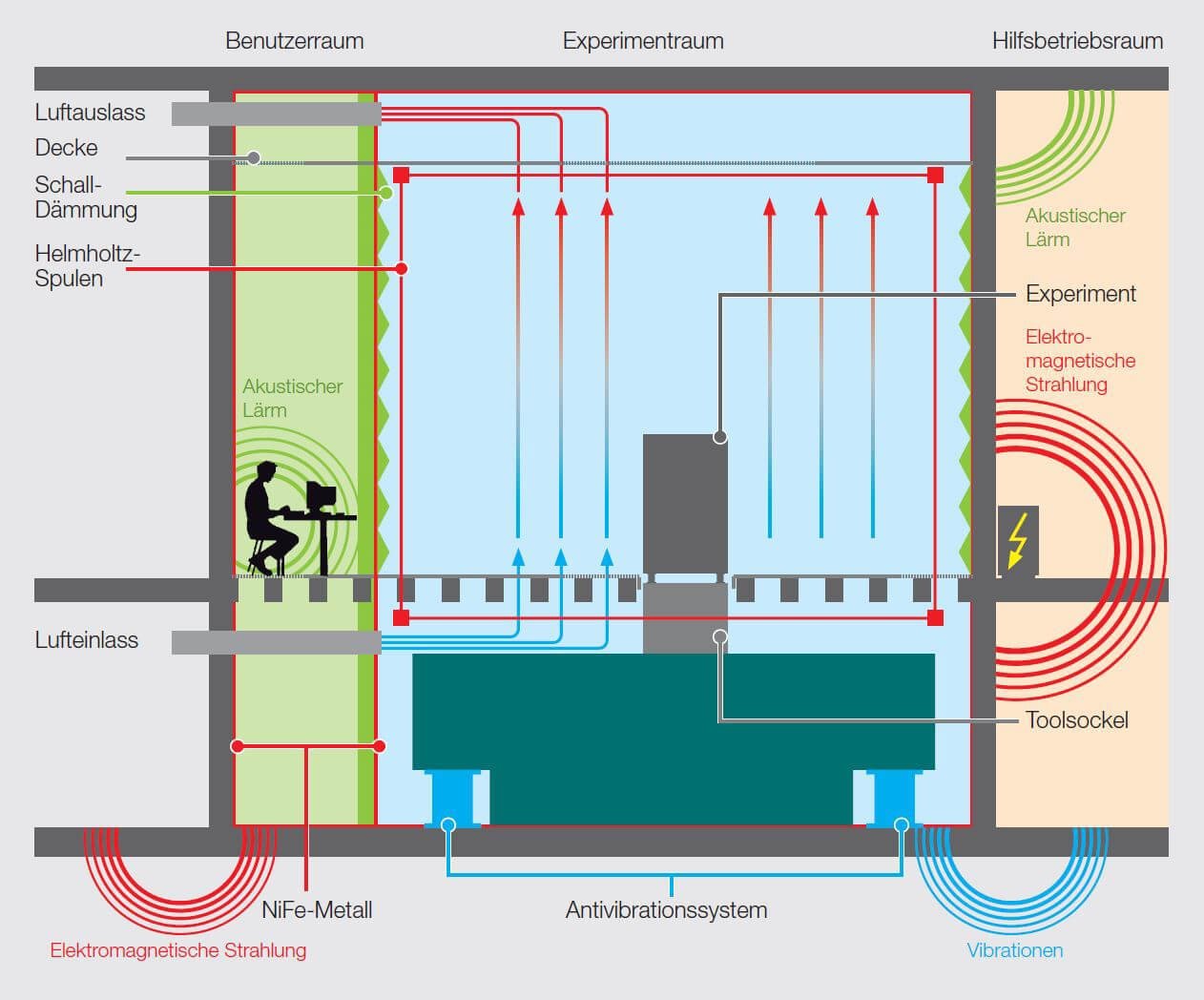
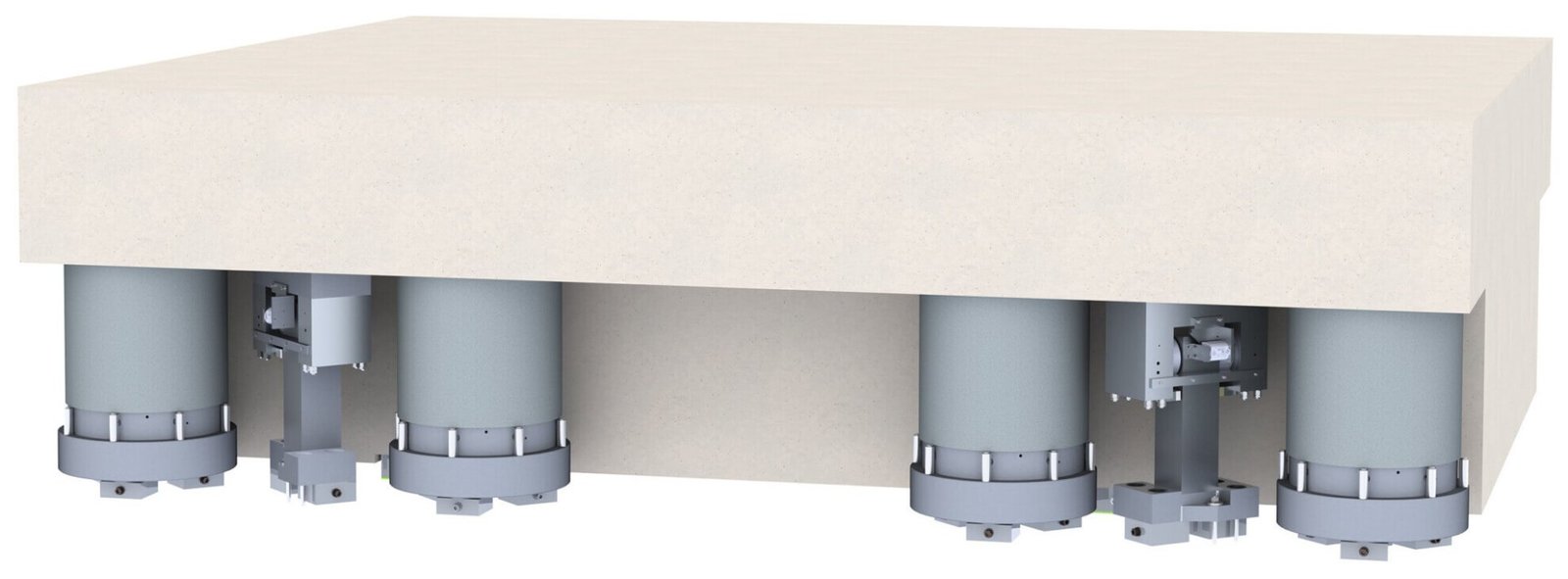
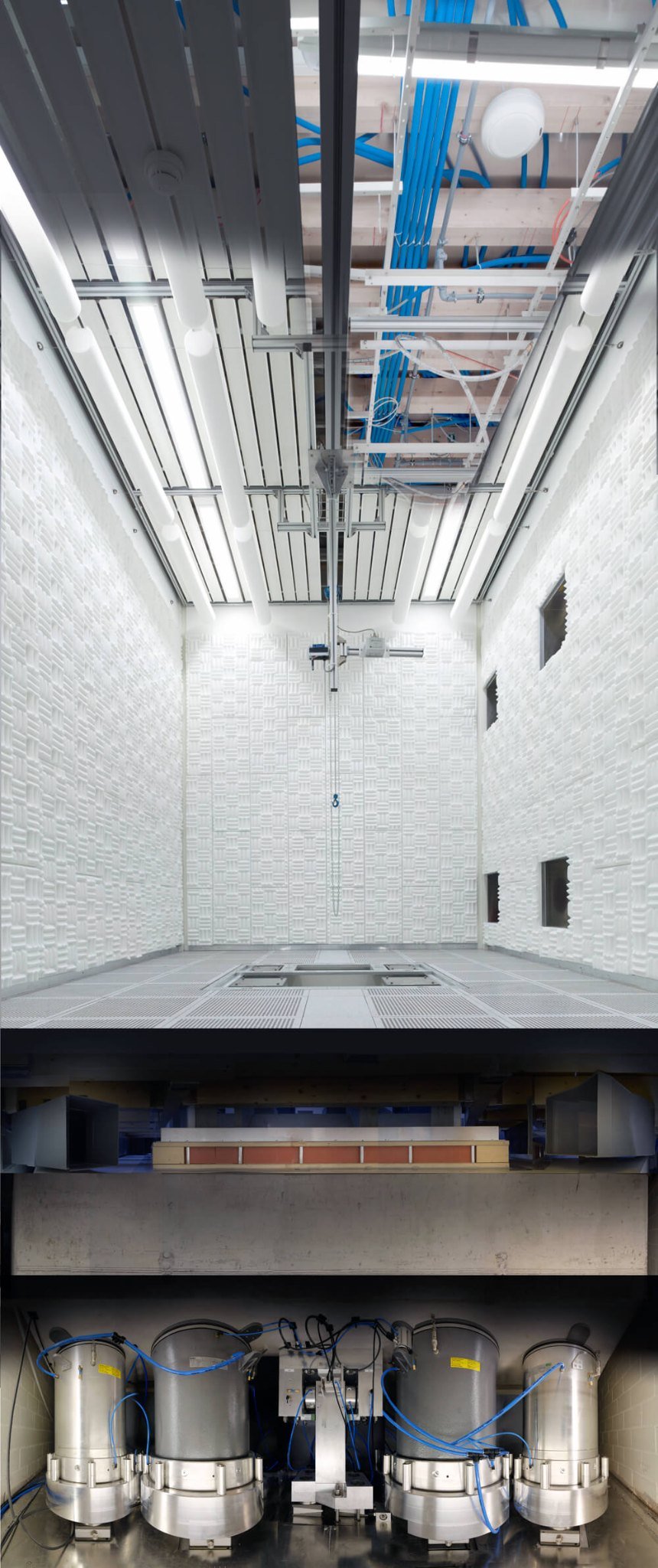
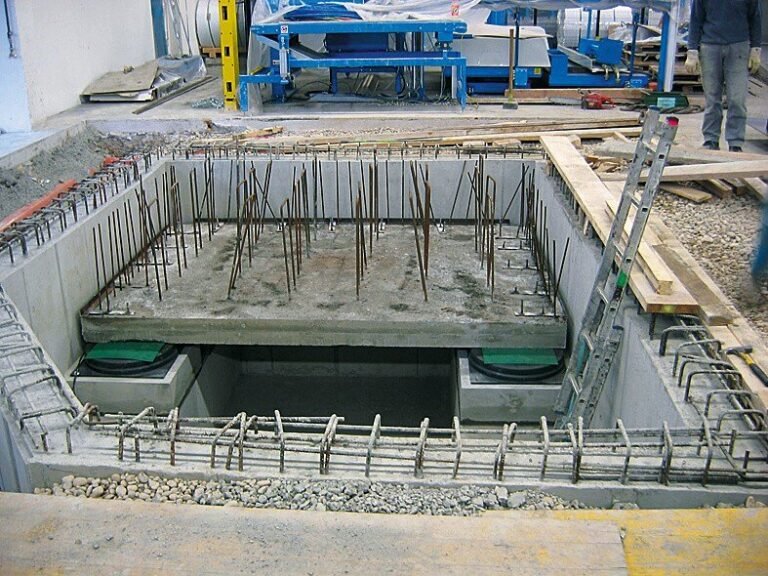
Each laboratory was equipped with a heavy concrete foundation block supported by an air cushion vibration isolation system.
The foundation blocks were designed with the highest practical mass to improve vibration isolation performance.
The natural resonance frequency of the air cushion system ranges from approximately 1.2 to 2.4 Hz.
The vibration isolators are actively controlled to maintain the required stability.
Sensitive experiments are installed on foundation blocks weighing between approximately 34 and 80 tonnes.
The laboratory users, on the other hand, move on a separate vibration-decoupled floor so that normal human movement does not interfere with sensitive experiments.
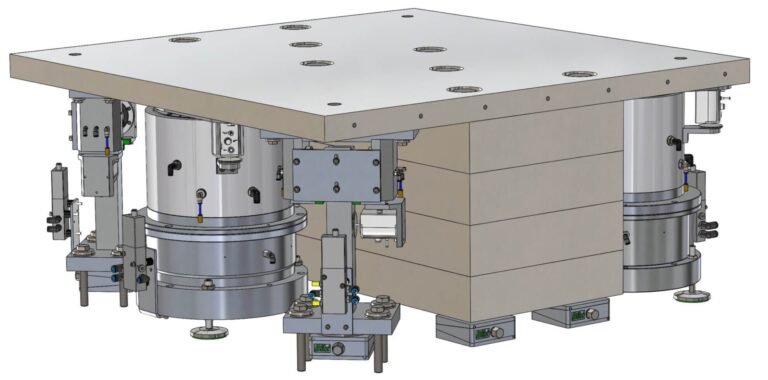
For this application, Bilz used the AIS™ Active Isolation System High Performance.
This active electro-pneumatic vibration isolation system is designed for applications with the highest requirements for:
- Isolation effectiveness
- Settling time
- Level stability
- Dynamic performance
The Solution
Results / Highlight
Bilz developed both the acoustic and vibration isolation solutions as part of one integrated system.
High-speed trains pass beneath the laboratory area.
Despite this significant external source of vibration, the experiments are sufficiently isolated so that train movement does not affect the measurements.
Task 2: Airborne Noise
The noise-free laboratories are used to investigate extremely small structures such as molecules and atoms.
At this level of sensitivity, even a conventional clean-room environment would still contain too much acoustic disturbance for certain experiments.
Solution 2: Sound Insulation and Optimised Room Acoustics
Bilz acoustic elements made from specialised foam were installed to improve room acoustics and provide effective airborne sound insulation.
These acoustic solutions are designed to absorb sound energy and significantly reduce unwanted sound pressure levels.
The system helps achieve:
- High sound absorption
- Improved airborne sound insulation
- Reduced sound pressure levels
- Shorter reverberation times
- Extremely quiet laboratory conditions
The result is a highly controlled acoustic environment with greatly reduced interference for sensitive nanotechnology experiments.
Project Statement
“Our strength as an innovative and reliable partner becomes especially clear in the development and installation of advanced research laboratories. In recent years, we have successfully implemented several similar projects, with further projects already in the planning stage.”
Dipl.-Wirt.-Ing. Ulf MotzProject Manager, Bilz Vibration Technology AG
Further Bilz Applications in Research
Bilz vibration isolation solutions are also used in several leading research institutions, including:
- Max Planck Institute for Solid State Research, Stuttgart
- Centre for Applied Quantum Technology (ZAQuant), Stuttgart
- Advanced Research Centre for Nanolithography (ARCNL), Amsterdam
- TU Delft – Faculty of Civil Engineering and Geosciences, Delft
- Radboud University – Institute for Molecules and Materials (IMM), Nijmegen
These applications demonstrate the importance of highly effective vibration and acoustic isolation in advanced scientific research environments where even extremely small disturbances can influence experimental results.
Looking for a similar solution?
Our application engineers help you select and size the right Bilz product for your machine and site.
Related Case Studies
Contact Us
Discuss your application with a Bilz specialist
Tell us about your machine, load and environment. Our engineers will recommend the right isolation, levelling or foundation solution for your project.
