

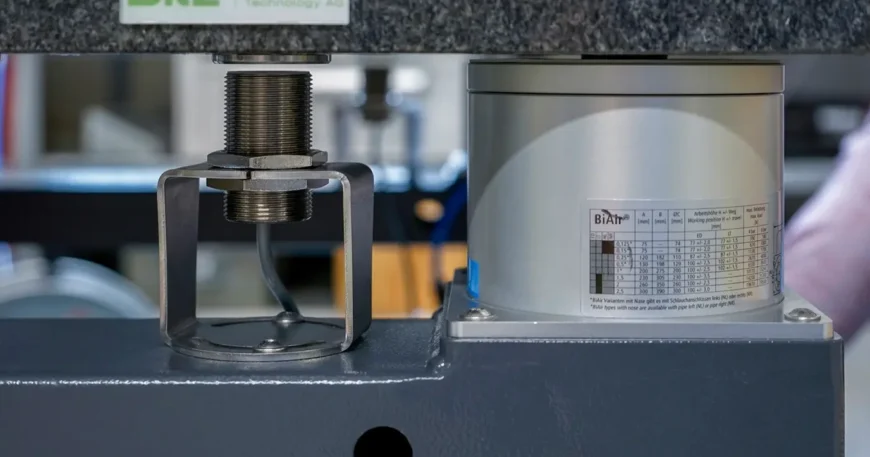
They operate without contact, precisely, and economically – yet inductive distance sensors remain a hidden gem for specialized applications. Their potential for intelligent sensor solutions in mechanical engineering, testing technology, and automation is enormous. Inductive distance sensors now measure with such accuracy that they can replace contact-based or very expensive measurement methods in many cases – provided the supplier possesses the necessary expertise. High-precision inductive sensors can, for example, measure heavy weights cost-effectively, detect angles in a space-saving manner, and even detect the slightest vibrations. A major advantage: the measurements are contactless and wear-free.
Electronic level control systems for precision machines
Because contactless distance measurement with inductive sensors offers further advantages, Bilz Vibration Technology AG had long been searching for a non-contact sensor solution for its new generation of level control systems. As an innovation-driven specialist in vibration isolation, Bilz offers, among other things, electronic level control systems for precision machines, vibration-sensitive and dynamic measuring machines, microscopes, laboratory tables, and testing and production machines in the semiconductor industry. The electronic systems actively compensate for vibrations and leveling errors using air springs. Measuring the distance to a hard stone slab or the machine itself plays a crucial role in enabling the rapid and precise detection of vibrations. Using these determined distance values, the control system dynamically adjusts the level of the individual air springs: the faster and more accurately, the better the vibration isolation works.
Vibration bridge eliminated thanks to contactless inductive solution
Until now, Bilz relied on tactile potentiometers for distance measurement. These use a movable metal pin to continuously detect the distance to the vibrating base plate. While this method is very accurate, it has a significant drawback. The metal pins, through contact with the base plate, create an undesirable vibration bridge that transmits disturbances to the air spring. “We wanted to eliminate this disruptive factor with contactless distance measurement using inductive sensors,” says David Brenk, Head of Development at Bilz.
One of the biggest challenges in the search for a contactless solution was that the desired inductive distance sensors had to measure the distance to the metallic reference points as accurately as the tactile potentiometers. To meet these demanding requirements – a 13 mm range with a resolution of <5 µm and stable linearity – a sensor specialist was needed who could extract the perfect combination of range and resolution from their inductive distance sensors.
Even the standard performance of Baumer ‘s precise Alphaprox IR30 sensor wasn’t quite sufficient for this demanding task, albeit only just. “After our initial selection tests, we realized that we would need to optimize the standard Baumer sensor for Bilz’s specific application,” reports Brenk. This was a challenge perfectly suited to the needs of Baumer sensor specialists Hansgeorg Haffelt and Toni Schnorr, who wanted to enable Bilz to achieve distance measurement without a vibration bridge. “At Baumer , we enjoy pushing the boundaries of what’s possible and are delighted when we can combine our expertise and high-performance sensors for innovative applications,” says Product Market Manager Hansgeorg Haffelt. In Bilz’s case, this meant that Baumer’s induction experts reduced the IR30’s range from 18 mm to 13 mm to achieve even higher resolution, shortened the standard length of the M30 housing due to the limited installation space, and replaced the connector with a space-saving cable exit.
Reduced deflections and decay times
The Bilz development manager is very pleased with the final product, which is now ready for series production: “In conjunction with our newly developed control system, we can now offer, for the first time, a non-contact electronic pneumatic level control (EPN) that isolates vibrations just as precisely and quickly as contact-based models. The reset accuracy of < ±0.01 mm is ideally suited for demanding applications in research and industry.” With this new generation of EPN, Bilz is setting new standards in non-contact height sensing. The company promises significantly reduced deflections and decay times compared to systems with tactile potentiometers, thanks to the precise measurement without mechanical influence. Further advantages of the cylindrical inductive sensors: They are infinitely height-adjustable thanks to the M30 thread and are wear-free.
Of course, Bilz isn’t stopping with this innovation. Brenk is already working on the next generation of electronic pneumatic level control. This system is intended to be fully digital and smarter. Among other things, it will utilize IO-Link sensors that not only record distance values but also provide diagnostic data for intelligently monitored operation. Holger Thissen, Baumer /rk
